
Ibiza cannot build its way out of demand. Most of the island is protected or non-developable, new permits are slipping, and the people who want a home here, residents, seasonal workers and international buyers, keep arriving. That is why prices hold up, why the best homes often change hands quietly, and why how you search matters as much as what you can spend.
We are an independent buyer agent, and we spend our days looking at what is really available across the Mediterranean, not just what is advertised. This guide explains where Ibiza’s scarcity comes from, what the latest figures say, and what it means if you are thinking of buying a second home, a family base or an investment.
TL;DR
- Around nine tenths of Ibiza’s land is non-developable, so supply is capped by geography and planning rules, not by a lack of builders.
- Permits for new multifamily homes have fallen, while detached houses make up a growing share of what is built.
- The shortage supports prices: the Balearic housing observatory puts the average 2025 transaction in Ibiza at €848,491, and advertised prices can sit well above what is actually paid.
- For buyers, scarcity means preparation, patience on price and access to off-market opportunities matter more than speed alone.
- Legal and planning checks on any property are not optional on an island where every plot is under scrutiny.
Table of Contents
- What “limited supply” really means on Ibiza
- The planning framework behind the scarcity
- What the latest figures show
- How scarcity shows up in prices
- Demand keeps pressing on a fixed stock
- Supply is not the same in every town
- A comparison from other island markets
- Our perspective
- How to buy well in a tight market
- Limited supply: advantages and drawbacks for buyers
- Talk to us about your Ibiza search
- FAQ
- Sources
What “limited supply” really means on Ibiza
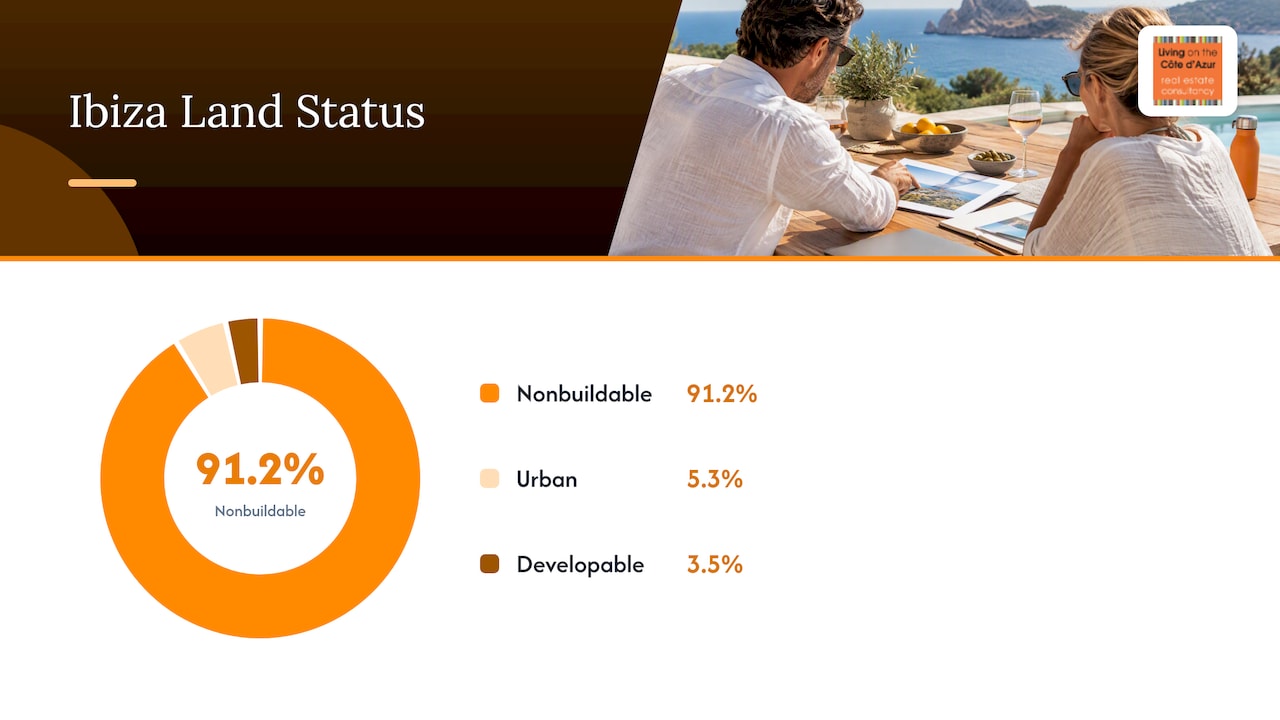
When people say Ibiza has limited supply, they often picture a handful of villas on a hill. The reality is more structural. The Ibiza Preservation Foundation’s 2024 report, using 2023 planning data, states that 91.2% of Ibiza’s land was non-developable, 5.3% urban and 3.5% developable. Put differently, almost everything that can be built in a conventional way has already been built, and the remainder is a thin slice.
Islandness adds another layer. A 2020 academic study on how insularity shapes the production of space identifies island conditions, higher transport costs, weaker mainland connectivity and the difficulty of reaching economies of scale as factors that curb real-estate development. The same study counted 79,080 secondary homes in coastal Balearic municipalities, against 1,077,520 in the comparable strip of the Mediterranean mainland. The point is scale: islands simply cannot flood the market the way a mainland coast can.
So supply on Ibiza is limited in three ways at once:
- Land: very little is classed as buildable.
- Rules: what can be built on rustic land is tightly controlled.
- Logistics: building is costlier and slower on an island.
We see the same pattern on the French Riviera, where steep hills, the sea and strict zoning keep the supply of prime homes tight. Ibiza simply feels it faster because the island is small.
The planning framework behind the scarcity
The rulebook is the Plan Territorial Insular de Eivissa (PTIE). The Consell d’Eivissa’s consolidated PTIE text, dated 25 June 2019, separates land into areas excluded from urban development, urban-development areas and controlled growth areas. It restricts parcelling and subdivision on rustic land, regulates isolated single-family housing and requires landscape and environmental integration.
For a buyer, this has practical consequences:
- A rural plot is not a future development site. Do not assume you can extend, subdivide or add a pool or guest house because the land looks large.
- Existing homes with a clean legal and planning history carry a premium, because they are almost impossible to replicate.
- Properties with unclear status can look like bargains and then prove difficult to finance, transfer or insure. Local lawyers describe how a home can exist physically but not legally, which is why due diligence on planning and ownership has become central to the market.
We go deeper on the rural side in our guide on what agents flag as rural risks for foreign buyers.
What the latest figures show
New building is tilting towards detached houses
On 13 March 2025, local construction and estate-agent associations said that scarce urban land was reducing multifamily construction and shifting building towards detached houses. The same report said foreign-client demand remained stable. Fewer apartments and more houses is a meaningful shift: apartments are the most efficient way to add homes on limited land.
The Ibiza Preservation Foundation’s report adds detail: in 2024, 450 of Ibiza’s 685 permitted new homes were multifamily and 235 were single-family.
Permits are slipping
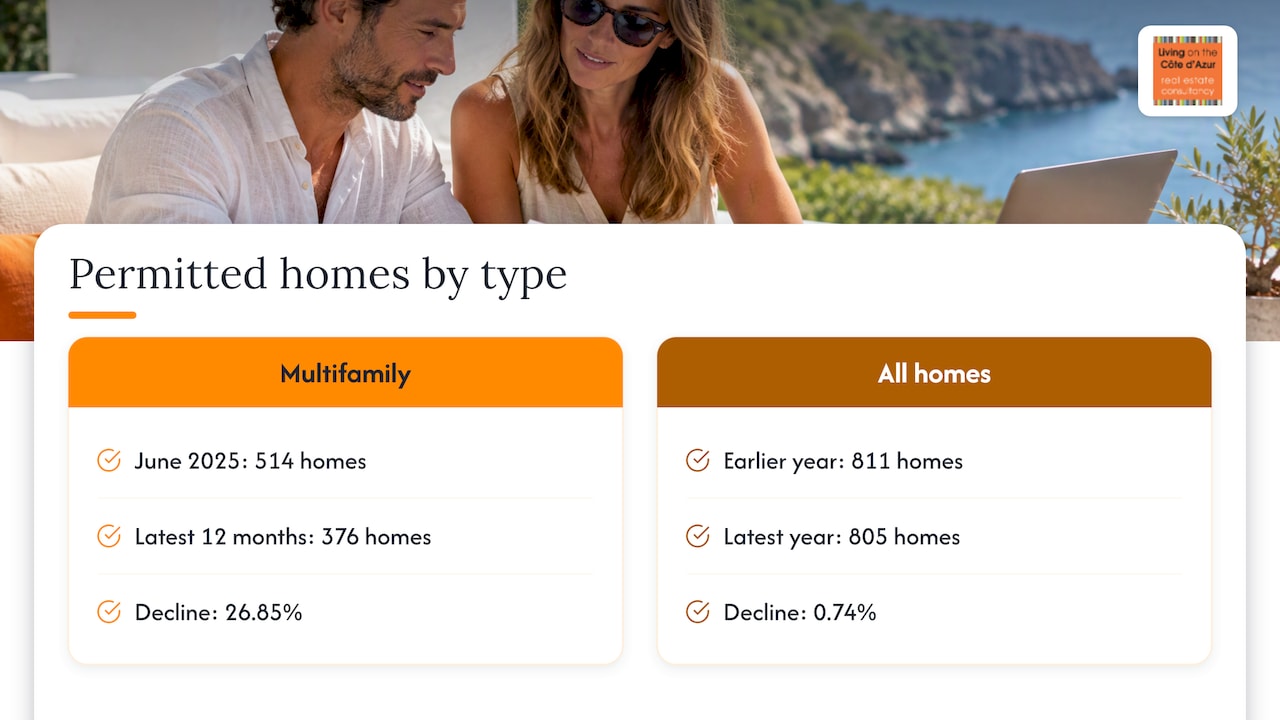
El Debate reported on 9 September 2026 that 376 free multifamily homes had been permitted in Ibiza and Formentera over the preceding 12 months, against 514 in June 2025, a fall of 26.85%. Total new permitted homes were almost flat, 805 against 811 a year earlier, a 0.74% decline. So the overall volume is small and steady, while the type of home is changing.
The same article notes that Ibiza’s architects consider the regional residential-strategic rules poorly matched to the island, because the transition-land characteristics they require are uncommon where multifamily buildings are concentrated in central urban areas. In other words, even the rules designed to unlock housing do not fit Ibiza’s geography very well.
The housing deficit
On 29 September 2026, the Balearic Government’s housing observatory reported an accumulated Ibiza housing deficit of 43.18% between 2000 and 2025, with population up 83% while housing grew 40%. That gap is the engine behind the pressure on prices and rents.
How scarcity shows up in prices
Scarcity does not mean every property rises every year. It means there is a floor under values, and that the cheapest route to a home, building one, is closed to most people.
The same observatory report put Ibiza’s average home transaction price at €848,491 in 2025, 48% above the Balearic average. It also said advertised portal prices in Ibiza municipality were about 32% above actual transaction prices. That second figure is the one buyers should remember: the asking price is the start of a conversation, not the market value.
Land tells the same story. On 30 March 2026, Noudiari reported an asking price of €1.6 million for roughly 756 square metres of land in Jesús, more than €2,100 per square metre. The president of the Ibiza construction association, Consuelo Antúnez, said land and construction costs for a six-home project there implied about €600,000 per dwelling before the final sale price.
This is why new-build prices start high and why existing homes in good locations are rarely cheap. Buying finished property is, in effect, buying something the island will struggle to produce again.
Our own piece on whether Ibiza is now too expensive to buy into looks at the pressure from tourism and whether stepping back is a real answer.
Demand keeps pressing on a fixed stock
Supply is only half the equation. Ibiza’s population swings dramatically through the year. IBESTAT’s April 2026 release reported that the island group’s maximum human-pressure ratio was 2.4 times its minimum in both 2024 and 2025. The indicator combines residents and seasonal populations using population estimates and passenger flows through Balearic ports and airports.
That means the island is built for one population and lived in by a much larger one for part of the year. Residents, seasonal workers, tourists and owners all compete for the same stock, and they do so on top of international purchasing.
International buyers are a visible part of this. The observatory data show that foreign buyers paid an average of €653,786 for a home in Ibiza, compared with €396,353 for national buyers. The gap reflects what foreign buyers tend to want: sea views, villas, finished homes close to the best towns and beaches.
Engel & Völkers, quoted in Diario de Ibiza in April 2026, viewed scarce buildable land, strict planning rules and controlled development in the Balearics as preventing supply from expanding as fast as demand, which supports prices and long-term asset values. That is a broker’s view rather than a guarantee, and no island market is immune to rate moves or changes in regulation. But the structural logic is hard to argue with.
If you want to see where the spending side is heading, our note on growing spending tourism in Ibiza shows why higher-end demand is so resilient.
Supply is not the same in every town
Ibiza is five or six very different markets in one. Supply and what you can realistically buy vary by area:
| Area type | What supply looks like | What it means for you |
|---|---|---|
| Ibiza Town and the urban core | Apartments concentrated in central urban areas, little room for more | Competition for well-located flats, and limited upside from new building |
| Sant Antoni | A draft plan envisages new homes on developable land | More future supply, but delivery depends on planning and timing |
| Santa Eulària and the east | Mix of established villas and rural plots | Clean, legal, existing villas are the scarce asset |
| North and rural interior | Heavily constrained rustic land | Renovation potential is limited by rules, so check before you commit |
For Sant Antoni, reporting on 27 August 2025 said the draft planning advance envisaged 1,961 new homes on developable land, including 427 affordable homes. The same report said the draft envisaged up to 17,342 homes on urban land, including 575 protected homes, and required 30% of buildable capacity in certain unconsolidated areas to be protected housing. These are plans, not completions, and much of the affordable component depends on delivery.
Public land is also moving slowly. SEPES, Spain’s public land agency, stated on 30 May 2025 that Ca n’Escandell covers 17.3 hectares, with about 90% reserved for public facilities and open space, including a 78,205-square-metre park. It would deliver 532 affordable homes, with about 197 planned in its first building parcel. Those homes serve residents, not the second-home market, so they do little to ease competition for villas and sea-view apartments.
If you are interested in what is coming through the pipeline, see our look at development projects in Ibiza to watch.
A comparison from other island markets
Ibiza is not unique. Wherever coastal land is scarce and desirable, the same dynamics appear: the best homes are few, planning is strict and buyers who prepare do better. If you want a point of comparison, there is useful reading on how island markets with scarce land behave for international investors. The lesson travels well: scarcity rewards the buyer who knows exactly what they want and moves with the right advice.
Our perspective
We work from the Côte d’Azur, and Ibiza is one of the Mediterranean markets we know through local agents, developers and off-market contacts. We have seen the same story in Cap d’Antibes and Saint-Tropez: when supply is tight, the market splits in two. There is the public side, what appears on portals, and there is the quiet side, where good homes are discussed between agents long before they are advertised.
Three things we tell every client looking at Ibiza:
- Do not confuse asking price with value. If advertised prices can sit well above actual transactions, a buyer without local data tends to overpay or walk away from good homes.
- Scarcity rewards clean paperwork. A property whose licences, registry entries and planning status line up is worth more here than a prettier one that does not.
- Buy the home you will actually use. Seasonal pressure means the island looks very different in August and in February. Visit in both before you decide.
Our role is to represent the buyer, not a listing. We search across agents rather than from one agency’s stock, and we coordinate the lawyers, tax advisers and notary-side steps so you are not carrying the process alone.
— Ab Kuijer
How to buy well in a tight market
- Define the brief precisely. Area, budget, size, rental intentions and must-haves. In a tight market, vague searches waste the few good opportunities.
- Look beyond public listings. Many of the best homes are shared privately between agents. Our guide to property for sale in Ibiza is a starting point, but the real search runs through a network.
- Test the price. Ask for comparable transactions, not just comparable listings.
- Audit the legal status. Check registry, planning licences, and any rural or coastal restrictions with an independent lawyer before signing anything.
- Plan for ownership costs. Taxes, financing and, if relevant, rental rules differ for residents and non-residents. Take advice from a Spanish tax adviser for your own situation.
- Be ready to move. Have your finance, identification and advisers lined up so you can act when the right home appears.
We also describe how our approach works in the buying process for a home in the South of France, which follows the same discipline.
Limited supply: advantages and drawbacks for buyers
Advantages
- A structural support for values, as brokers and housing data point to demand outpacing what can be built.
- Rarity of finished, well-located homes, which tend to be easier to resell.
- A resilient international buyer base and a long season for rental use, subject to the rules for tourist lets.
Drawbacks
- Higher entry prices, and land that is very expensive relative to what a plot can legally become.
- Less choice, which can pressure buyers into rushed decisions.
- Regulatory risk: rules on tourist rentals, building and land can change, so check the current position before you buy.
- No guarantee of appreciation. Scarcity supports values but does not remove market cycles.
Talk to us about your Ibiza search
If you are considering Ibiza, we can run a confidential search across local agents and off-market contacts, check the legal and planning position of shortlisted homes and negotiate on your behalf. Our buyer broker and full-service approach is listed at 2%, and our search mandate is the simplest way to start. Send us a short brief through our website with your budget, preferred area and timeline, and we will tell you honestly what the market can offer.
FAQ
Why is there so little property for sale in Ibiza?
Most of the island is non-developable, and the rules for rustic land are strict. Building is also costlier on an island. Together these keep new supply small compared with demand.
Does limited supply mean Ibiza prices will always rise?
Not necessarily. Scarcity supports values over the long run, but prices still respond to interest rates, the wider economy and regulation. Treat it as a floor of demand, not a promise of growth, and speak to a financial adviser about your own plans.
Are new-build homes the answer for buyers?
Sometimes, but new multifamily permits have been falling and land is expensive, so new-builds tend to launch at high prices. They suit buyers who want modern specifications and are comfortable with delivery timelines. We look at what is coming in our guide to real estate trends in Ibiza.
Can a foreign buyer use a buyer agent in Ibiza?
Yes. A buyer agent works for you, searches across agents and coordinates lawyers, tax advisers and the notary-side process. It is particularly useful when the best homes are not widely advertised. Read more on what a buyer agent does.
How should I check an Ibiza property before buying?
Ask an independent lawyer to verify the registry entry, planning licences and any coastal or rural restrictions. Compare the asking price with real transactions rather than other listings.
Sources
- Ibiza Preservation Foundation, 4 Islands Report 2024
- La isleidad como condicionante de la producción del espacio (2020)
- Consell d’Eivissa, consolidated PTIE
- Almar Lawyers, legally difficult properties in Ibiza
- Periódico de Ibiza, construction and urban land, 13 March 2025
- El Debate, building permits in Ibiza, 9 September 2026
- Periódico de Ibiza, housing deficit report, 29 September 2026
- Noudiari, land prices in Jesús, 30 March 2026
- IBESTAT, human pressure indicator, April 2026
- Diario de Ibiza, Engel & Völkers view, 28 April 2026
- Periódico de Ibiza, Sant Antoni draft plan, 27 August 2025
- SEPES, Ca n’Escandell, 30 May 2025
Recommended
 //