
On the French Riviera, a home near a marina is only as useful as the berth that goes with it, and the two are rarely sold together. Berths are scarce, they are usually a right to use public waterfront rather than something you own, and the terms differ from port to port. A buyer who understands this before viewing can shortlist the right harbours, price the whole package honestly and avoid paying a premium for a promise that cannot be transferred. As an independent buyer agent, we work only for the buyer and search the whole market, which is exactly the vantage point this decision needs.
TL;DR
- A property “with marina access” does not automatically include a berth. Berth rights are a separate legal matter and must be confirmed in writing with the port.
- In French ports, you generally hold a right of use over public maritime domain, not ownership. Contracts such as the garantie d’usage run for a fixed term, up to 35 years under the Code des transports.
- Annual fees depend heavily on port and boat length, and waiting lists for permanent berths can be long.
- Match the berth to your boat’s length, beam and draught before you fall in love with a house.
- Our buyer agent service is free to the buyer, and our fee for buyer broker work is 2%, paid through commission-sharing with the selling agent.
Table of Contents
- What marina access really means for a buyer
- Why berths are the real constraint
- You rarely own the berth
- Concession expiry: a date to put in your diary
- Does the boat fit the berth?
- What marina access costs
- How a berth affects value and resale
- Reading the Riviera’s marinas
- Due diligence checklist before you buy
- How we help you buy with marina access in mind
- FAQ
- Sources
What marina access really means for a buyer
When listings talk about marina access, they can mean four quite different things: a villa or apartment with its own private quay on a canal, a home within walking distance of a harbour, a home inside a private marina village such as Port Grimaud, or a property that comes with a right to a berth. Each gives a very different daily life.
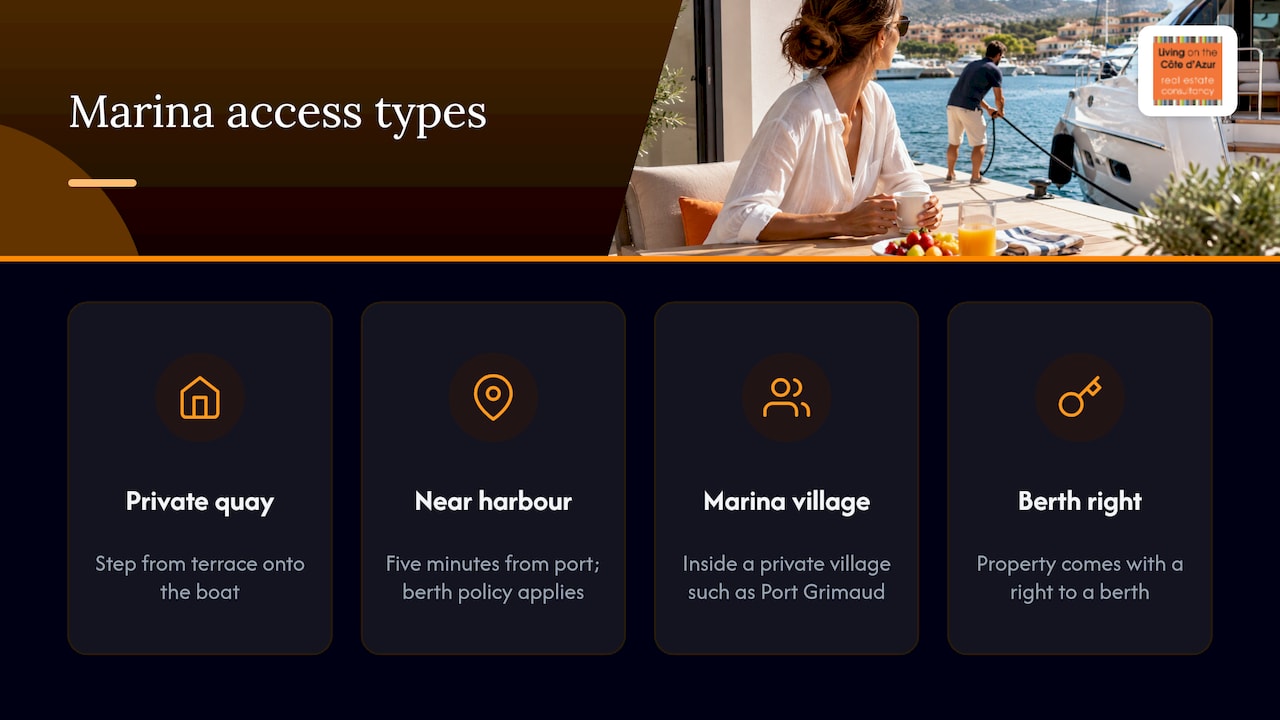
A private mooring at the foot of the garden means you step from the terrace onto the boat. A flat five minutes from the port means you still depend on the harbour’s berth policy. We have found it helps to write down which of these you actually want before the search starts, because it changes the towns, the budgets and the property types we look at. If you are still exploring the waterfront end of the market, our page on French Riviera waterfront properties shows what that segment looks like.
Why berths are the real constraint
The Riviera has far more boats than places to keep them. A study of French yacht harbours from the Université Côte d’Azur’s research archive notes that the federation of yachting harbours estimated 50,000 to 80,000 moorings were lacking, and that the coastal protection law of 1986 and an emphasis on preserving the shoreline led to a freeze on new harbour projects. Supply is therefore close to fixed while demand follows the region’s wealth.
That scarcity is why marina access matters so much to buyers. It is also why it shows up in the price of the right homes: a property whose owner can offer a transferable, properly documented berth solves a problem most buyers face for years.
You rarely own the berth
This is the point that surprises most international buyers. Under French law, port berths sit on public maritime domain. The Côte d’Azur academic study reports that many shareholders in private harbours only learned they could not literally own their moorings when public-leasing contracts were drawn up.
Three structures are worth knowing:
- Annual berth. A one-year personal authorisation from the port. It is not an asset, and port rules commonly stop it passing automatically with a boat or a property.
- Garantie d’usage (formerly amodiation). A contract with the port operator guaranteeing use of a berth, or a berth in a zone, for a long term. A professional commentary on the Code des transports explains that article R. 5314-32 allows these contracts for up to 35 years in return for financing port works, with letting only through or with the consent of the port operator.
- Shares in a private concession company. In older private ports, occupying a mooring has meant buying shares in proportion to the berth’s size, giving a right of use until the concession ends.
A Montpellier lawyer cited in the same commentary reads the garantie d’usage as closer to a reservation right than a property right. For a buyer, the practical conclusion is simple: treat a berth as a time-limited right, check the remaining term and ask your notaire or a maritime lawyer to read the contract before you pay.
Why “sold with a berth” needs checking
Some listings imply that a berth comes with the house. A berth right belongs to a contract between the holder and the port, so it only moves if the contract and the port allow it. Mooring guidance for the Côte d’Azur advises confirming in writing that a seller’s berth transfers, and verifying rights directly with the harbour office and a legal adviser. We build that written confirmation into our offer conditions whenever a berth is part of the deal, so the question is settled before you are committed.
Concession expiry: a date to put in your diary
Several private ports on the Riviera were built under 50-year concessions. A specialist yachting FAQ notes that concessions expire between 2016 and 2027, after which the port passes to public management by the town hall or a designated authority. The same source says former leaseholders are generally expected to keep priority to rent if they use the berth for their own boat and still need the same size.
What this means for you: a berth in a port whose concession is ending is a different proposition from one in a port with a freshly issued long contract. Ask for the remaining term, the successor arrangements and any change to charges. Contracts that have a fixed end date also lose years of use over time. A July 2026 analysis in Superyacht Guide describes a berth with a set expiry as a wasting asset unless scarcity compensates, so the remaining term belongs in your valuation.
Does the boat fit the berth?
Daily convenience depends on practical details that never appear in a listing headline. A Côte d’Azur broker’s guide to buying berths lists stern-to, bow-to and side-on mooring as three options with different ease of boarding and manoeuvring. Before you commit, check these with the harbour office:
- Length overall, beam and draught of your boat against the berth’s usable dimensions and the depth.
- Manoeuvring space from the canal and the route from the berth to the port exit, including narrow passages or bridges.
- Shore power, water, and any restrictions on vessel type or use.
- Whether you can let the berth when you are away, which usually runs through the port.
If you are a sailing family who wants to leave in minutes, or a motor yacht owner who needs deep water and a short run to open sea, these points should decide between Antibes, Cannes, Villefranche-sur-Mer or Saint-Tropez long before the house does.
What marina access costs
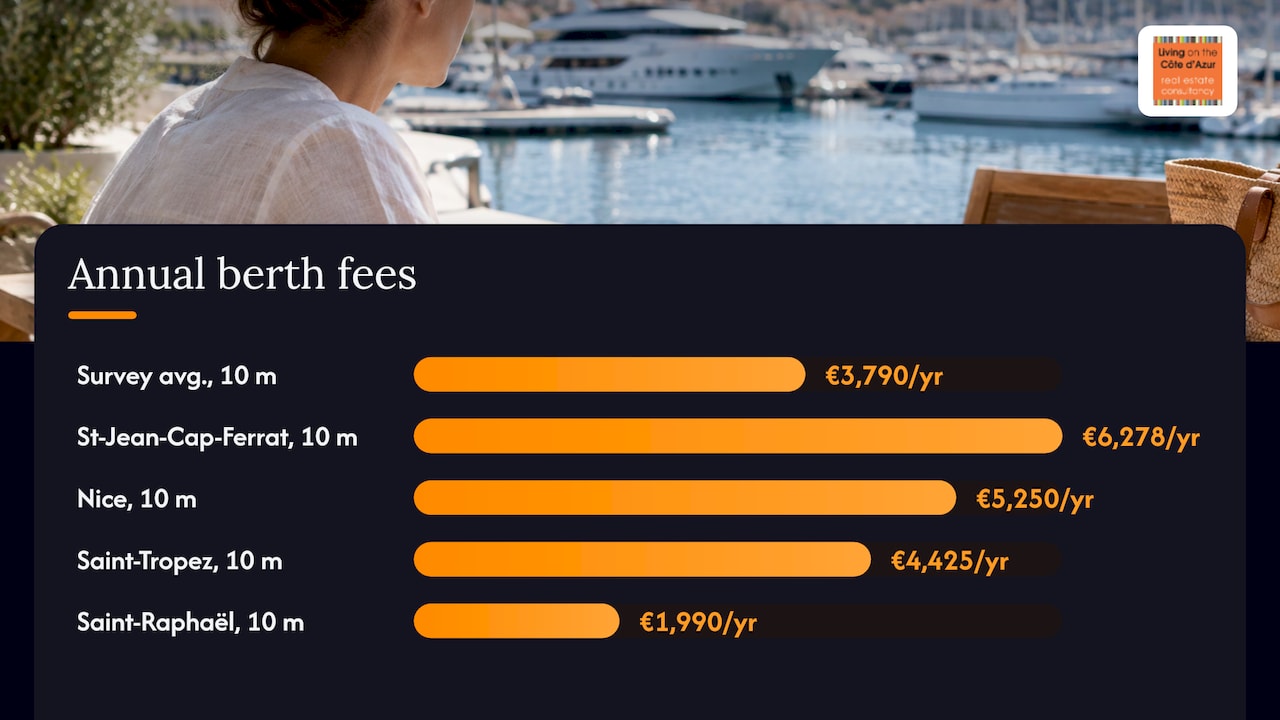
Costs split into a one-off right to use a berth and the annual running fees. Figures vary by port, season and year, so use the following as orientation and confirm with the port.
| Item | Indicative figure | Source |
|---|---|---|
| Average annual fee, 10 m boat, 32 French Mediterranean ports (2021 survey) | €3,790 | Giornale della Vela |
| Average annual fee, 12 m boat (same survey) | €5,159 | Giornale della Vela |
| Saint-Jean-Cap-Ferrat, 10 m / 12 m | €6,278 / €9,879 | Giornale della Vela |
| Nice, 10 m / 12 m | €5,250 / €7,410 | Giornale della Vela |
| Saint-Tropez, 10 m / 12 m | €4,425 / €5,099 | Giornale della Vela |
| Saint-Raphaël, 10 m / 12 m | €1,990 / €2,804 | Giornale della Vela |
These are 2021 survey figures, so expect current tariffs to be higher. A 2026 price guide puts Côte d’Azur floating berths at €5,000 to €9,000 a year for 10 m, with extras such as water, electricity, haul-out and port taxes adding to the base fee, and waiting lists for permanent berths running to several years. Public ports are generally regulated and more affordable than private marinas, according to a comparison of French port tariffs.
At the top end, the picture changes. An analysis of the Mediterranean mooring shortage reports that leasehold positions at Antibes’ IYCA trade from a few hundred thousand euros for modest berths to many millions for 50-metre-plus positions. Superyacht owners increasingly secure tenure before buying the vessel.
How a berth affects value and resale
A home that offers reliable boating is easier to sell to the many buyers who share the dream, and a transferable berth right adds to that. The same Superyacht Guide piece observes that a berth can behave economically like property while legally being a time-limited right. The sensible way to value it is to weigh scarcity against remaining term, annual charges, maintenance contributions and any limits on subletting.
For investors, there is one more angle: a harbour-side apartment can be let to boat owners and sailing guests, which we cover for rental buyers in our guide to buying a rental property on the Côte d’Azur.
Reading the Riviera’s marinas
Each harbour has its own character, which is why we start with lifestyle rather than listings.
- Antibes (Port Vauban). The largest yachting hub, with a long-established superyacht scene. Port Vauban uses guarantee-of-use contracts for vessels over 13 metres, securing berthing within a zone for up to 21 years rather than a fixed physical berth.
- Saint-Tropez and the Gulf. Glamour and a lively harbour, but free berths are hard to find. Port Grimaud suits owners who want a canal-side home with a mooring at the door, and its public consultation record confirms usage-guarantee contracts run up to a maximum of 35 years.
- Saint-Jean-Cap-Ferrat and Villefranche-sur-Mer. Deep water and postcard scenery close to Monaco, and among the most expensive annual fees in the survey above.
- Nice, Cannes and Mandelieu. City life plus harbours, so a flat can be a lock-up-and-leave base.
The market for each changes, so we pair the search with current availability rather than a fixed list. Our overview of the Riviera property market explains how we read it.
Due diligence checklist before you buy
- Ask the seller and agent exactly which right is included: annual authorisation, garantie d’usage, concession shares or none.
- Get the contract and the port’s regulations, and have a lawyer or the notaire review them. The step that gives the port its say is part of the process, not an obstacle.
- Confirm the remaining term, the successor regime if a concession ends, and the transfer fee.
- Obtain the port’s written consent to the transfer before paying any berth premium.
- Check dimensions, depth and access against your boat, as above.
- Add annual fees and extras to your running-cost budget.
- Understand the wider purchase steps in our guide to the legal process of buying in France.
The notaire, a French public official who handles the legal transfer of property, deals with the house. The berth contract is separate, so someone needs to coordinate both timelines. That coordination is part of the work we do on your behalf.
Our perspective
We meet many buyers who start with the house and treat the boat as an afterthought. We would turn that round. On the Riviera, the berth is the scarcest piece of the puzzle, so we ask clients about the boat, the cruising plans and how often the family will really be on the water before we ever open a listing.
Because we represent only the buyer, and search the whole market through local agents, developers and off-market contacts, we can compare a canal-side villa in one town with an apartment near a harbour in another, without a listing of our own to favour. We then bring in trusted notaries, tax advisers and other local experts so that the property and the berth are checked together.
The result we aim for is simple: a home that suits how you live on the water, with the rights documented before you commit.
Ab Kuijer
How we help you buy with marina access in mind
We are an independent international buyer agent. We define your search with you, source and compare properties across the Côte d’Azur, arrange viewings, negotiate and coordinate the purchase through to the notaire. Our buyer broker service carries a 2% fee, and our buyer agent services are free to the buyer, as we are paid through commission-sharing with the selling agent. You can read how it works on our full-service buyer broker page or start with a search mandate. Tell us your boat, your harbour shortlist and your timeline, and we will come back with a plan.
FAQ
Does buying a Riviera home guarantee a berth?
No. A berth is a separate right granted by the port, not an automatic part of the property. Any transfer depends on the contract and the port’s consent, so confirm it in writing before you pay.
Can I own a berth outright in France?
Generally not. Berths lie on public maritime domain, and what buyers acquire is a right of use, such as a garantie d’usage of up to 35 years, or shares in a private concession company.
How much does a berth cost each year?
It depends on port and boat length. A 2021 survey of French Mediterranean ports found averages of €3,790 for 10 m and €5,159 for 12 m, with Saint-Jean-Cap-Ferrat among the dearest. Current tariffs are published by each port, so ask for the latest list.
Is a marina-side home a good investment?
Scarcity supports demand, but value depends on the property, the berth term and the running costs. We look at each case with the remaining contract length and charges alongside the house price.
Sources
- Governance of French yacht harbours, Université Côte d’Azur
- L’occupation des postes d’amarrage dans les ports de plaisance, proprietespubliques.fr
- Port de Grimaud public consultation record, 12 September 2024
- Marina berths in France: fees and situations, Giornale della Vela
- Why Superyacht Marina Berths Have Become Investment Assets, Superyacht Guide
- Mooring and marinas on the Côte d’Azur
- End of concessions of private ports
- 7 tips for buying a berth
- Place de port en France 2026
- Tarifs des places de port en France
- Mediterranean superyacht mooring shortage 2026
Recommended
 //