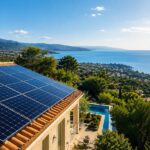
When we moved to the South of France around 20 years ago, installing solar panels seemed like an obvious choice.
After all, we had moved to one of the sunniest regions in France. Why wouldn’t we use all that free energy falling on our roof?
So we looked into it.
At the time, however, the numbers simply didn’t convince us. Photovoltaic installations were considerably more expensive than they are today, the technology was less mature, and based on the quotations and calculations available to us at the time, the expected payback period was simply too long.
Government incentives were also changing, making the financial calculation less predictable.
For us, solar energy made environmental sense — but not enough financial sense.
So we didn’t do it.
Twenty years later, the solar panel calculation has changed
Today, we have come to a very different conclusion.
Not because the sun shines more than it did 20 years ago, but because almost everything else has changed.
Solar panels have improved considerably. Modern photovoltaic panels typically have an expected lifespan of around 25 to 30 years, according to the French government, although components such as the inverter may need replacement earlier.
At the same time, the price of electricity has moved dramatically in the opposite direction.
According to official French statistics institute INSEE, the French household electricity price index stood at 72.0 in 2006. By 2025, it had reached 146.9.
In other words, despite some year-to-year fluctuations, French household electricity prices have more than doubled since 2006.
And the increases have not only been gradual.
Official French government statistics show that the average residential electricity price reached €280 per MWh in 2024 — equivalent to €0.28 per kWh — an increase of 18.4% in just one year, following an increase of 14.4% between 2022 and 2023.
But doesn’t France have cheap nuclear electricity?
This is an interesting question.
France does indeed have one of the world’s largest nuclear electricity systems.
In 2025, nuclear power stations produced 373 TWh of electricity and accounted for 68.1% of French electricity generation. Nuclear and renewable sources combined represented an extraordinary 95.2% of electricity generated in mainland France.
France therefore produces remarkably low-carbon electricity.
But that does not mean the electricity arriving at your villa is inexpensive.
Your electricity bill consists of much more than the cost of producing an electron in a nuclear power station. It also includes the electricity network, taxes, levies, supplier costs and the wider economics of the French and European electricity market.
In 2024, for example, the average French residential electricity price of €280/MWh consisted of approximately:
€150/MWh electricity supply
€65/MWh network costs
€65/MWh taxes.
So less than 54% of the final residential electricity price was the electricity supply component itself.
This helps explain an apparent contradiction:
France can produce enormous quantities of relatively low-carbon nuclear electricity while household electricity bills still rise significantly.
And that changes the solar calculation
Twenty years ago, we were comparing an expensive photovoltaic installation with relatively inexpensive grid electricity.
Today, the equation is different.
You are comparing modern solar panels with a typical lifespan of 25–30 years against electricity prices that, according to INSEE, have more than doubled since 2006.
And there is another important difference for property owners on the Côte d’Azur.
Many villas consume a lot of electricity exactly when solar panels are producing it:
- swimming pool filtration during the day;
- air conditioning during hot sunny afternoons;
- heat pumps;
- electric water heating;
- electric vehicles;
- guest accommodation;
- summer kitchens and pool houses.
That makes self-consumption particularly interesting.
Instead of asking:
“How much will somebody pay me for the electricity from my roof?”
the more relevant question increasingly becomes:
“How much expensive electricity can I avoid buying from the grid?”
That is a fundamentally different economic calculation.
We were sceptical then. That’s exactly why we’re interested now.
We haven’t suddenly become solar salespeople.
In fact, our own experience is one reason we approach solar energy differently.
Twenty years ago, we looked at the numbers and decided not to invest.
Today, we have looked at the numbers again — and the economics, technology and energy market have changed considerably.
That doesn’t mean every villa should have 20 solar panels.
It doesn’t mean everybody needs a battery.
And it certainly doesn’t mean that every solar quotation is a good investment.
It means that solar energy on the Côte d’Azur deserves to be calculated properly again.
And this time, the numbers can be surprisingly convincing.
Contact us to connect with our Premium Network to get a fair calculation and advise from our partner in solar panels.
More info about solar panels
"*" indicates required fields
 //
//